

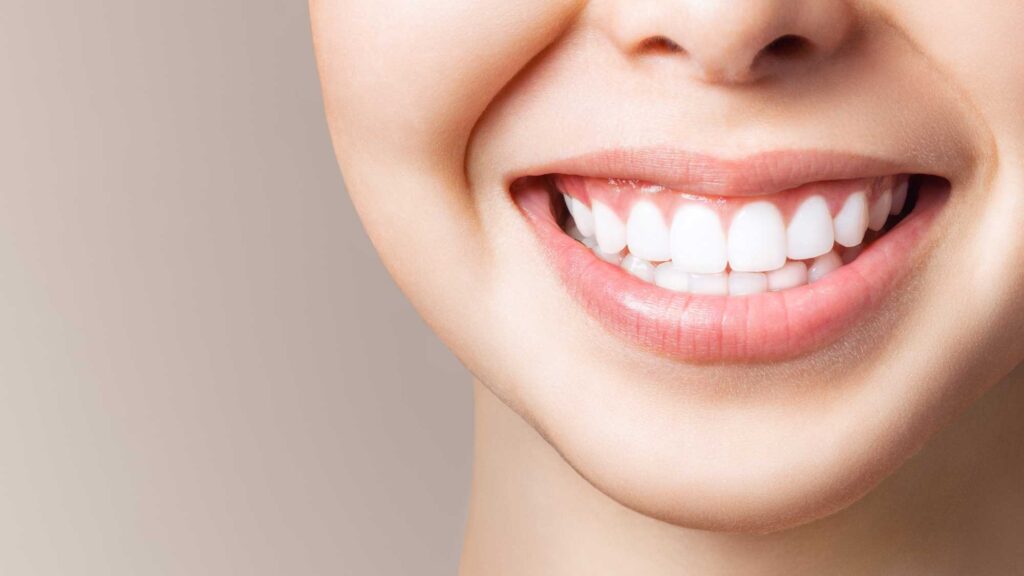
Your smile is a fundamental part of your image: a gesture we use to communicate and one that reveals our deepest feelings and our mood. In this article we explain how teeth whitening can help you show it off.
There’s no doubt that a beautiful smile gives us confidence. But how do you get one?
You switch on the TV and see presenters, actors and celebrities with film-star smiles and perfect, dazzling white teeth. How do they do it? You brush your teeth after every meal, use mouthwash and floss… and yet your teeth still aren’t as white as you’d like.
Let’s start at the beginning:
Teeth are not completely white! Plain and simple, no anaesthetic…
Don’t look for a pure white smile, because it doesn’t exist and, if it did, it wouldn’t look natural at all: tooth enamel is a translucent bluish shade that lets the yellow of the dentin show through.
But teeth do turn yellow, and quite a lot. We see it in the mirror, don’t we? That awful ochre yellow that breaks our heart… So, first of all, let’s look at the:
Factors that turn our smile yellow
Because that’s how it is: there are a number of things that darken, tint and stain our teeth, starting with certain foods and drinks that stain your teeth:
- Drinking wine, tea, coffee or cola.
- Smoking.
- Eating certain foods with strong colouring, such as carrots, chocolate, oranges…
- Taking certain medicines.
- The presence of bacteria.
- Using some mouthwashes or oral rinses.
- The passing of time: age.
And for all of this…
There is a solution! Types of teeth whitening
First of all, before starting any teeth whitening treatment, your teeth need a professional clean to remove surface stains, plaque, tartar… Once that’s done, we move on to the whitening itself.
There are several treatments to bring back the whiteness of your teeth. Which one is used depends on how stained or discoloured they are: your dentist will suggest the option that suits you best and you will decide. With this in mind, the options are:
- At-home whitening with trays: the trays are custom-made to fit your teeth, placed over them and gradually release a substance that helps improve their colour. This treatment is carried out at home. Your dentist takes an impression of your teeth to make the whitening tray, which holds the whitening product and which you’ll wear at home for 4 to 5 hours a day. The treatment lasts around 15 days and is done first on the upper arch and then on the lower one. This way you reach the shade you want and can gradually see the difference in colour between one set of teeth and the other.
- Whitening toothpaste: this is a very light, superficial whitening, as toothpaste contains ingredients that help teeth look less yellow, but it won’t give you a smile like the ones in adverts.
- Laser whitening: it costs more than the previous options, but the results are clearly visible and immediate. The treatment involves applying hydrogen peroxide to the surface of the tooth and activating it with a special light so it can do its whitening work.
- Internal tooth whitening: a more invasive treatment, used on teeth that have already had the nerve removed, in which the whitening agent is placed inside the tooth.
While you’re having teeth whitening, it’s best to avoid the staining foods we mentioned earlier. This makes the treatment quicker and more effective. As for tobacco, you should avoid it during the process, as it stops the whitening agent from doing its job.
During whitening, your teeth may become more sensitive to cold or heat when you eat and drink, because of the hydrogen peroxide. But this sensitivity fades once the treatment is over. If it becomes very intense, the treatment can be paused for a few days and then resumed.
It’s worth making clear that sensitivity doesn’t always appear: some people will notice it and others won’t. What’s more, people who already have tooth sensitivity can also have hydrogen peroxide whitening, as it won’t necessarily get worse. Even so, in these cases it’s best to mention it to your dentist, who can minimise the problem with a toothpaste designed for sensitive teeth.
Once you’ve reached the whiteness you want, it’s a good idea to have a professional dental clean every 6 months to remove the stains that food leaves on your teeth, and to have a whitening top-up from time to time, as your dentist recommends.
Finally, it’s worth pointing out that whitening is not harsh on your teeth: it doesn’t wear them down. It’s a completely safe treatment that will let you smile openly, just the way you like. If you’d like to know which type of whitening is right for you, book your appointment and we’ll advise you.
