

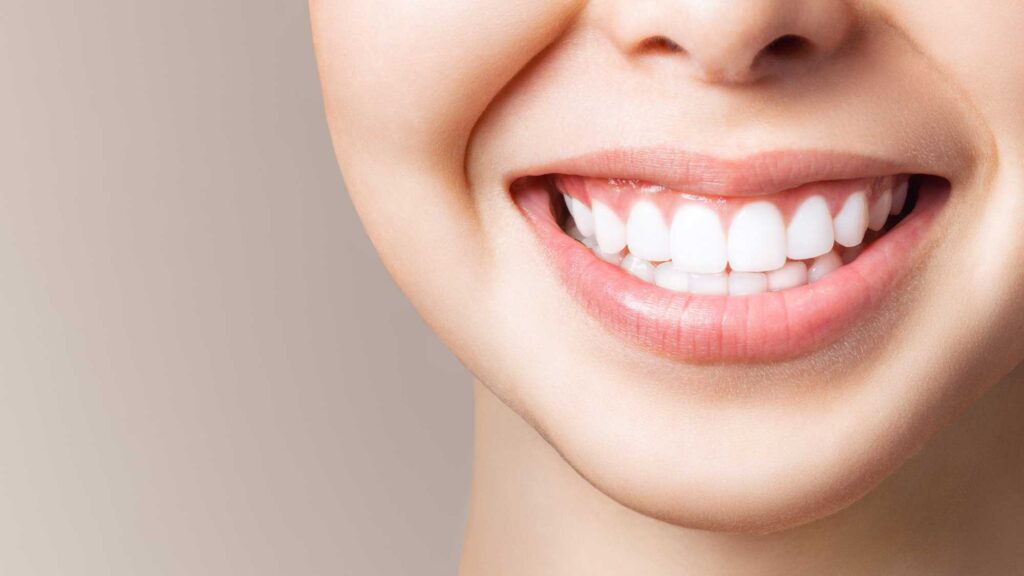
Your smile is a fundamental part of your image: a gesture we use to communicate and one that reveals our deepest feelings and our mood. If you want lighter teeth, the first step is to know the types of teeth whitening available: in-clinic whitening, take-home whitening with trays and internal whitening, plus whitening toothpastes as a complement. In this article we explain how each one differs and who it is suitable for.
There’s no doubt that a beautiful smile gives us confidence. But how do you get one?
You switch on the TV and see presenters, actors and celebrities with film-star smiles and perfect, dazzling white teeth. How do they do it? You brush your teeth after every meal, use mouthwash and floss… and yet your teeth still aren’t as white as you’d like.
Let’s start at the beginning:
Teeth are not completely white! Plain and simple, no anaesthetic…
Don’t look for a pure white smile, because it doesn’t exist and, if it did, it wouldn’t look natural at all: tooth enamel is a translucent bluish shade that lets the yellow of the dentin show through.
But teeth do turn yellow, and quite a lot. We see it in the mirror, don’t we? That awful ochre yellow that breaks our heart… So, first of all, let’s look at the:
Factors that turn our smile yellow
Because that’s how it is: there are a number of things that darken, tint and stain our teeth, such as wine, tea, coffee, cola, tobacco, some medicines and mouthwashes, bacteria or simply the passing of time. We explain what they are and how to avoid them in our article on foods that stain teeth.
And for all of this…
Types of teeth whitening: in-clinic, at home and internal
First of all, before starting any teeth whitening treatment in Vélez-Málaga, your teeth need a professional clean to remove surface stains, plaque, tartar… Once that’s done, we move on to the whitening itself.
There are several treatments to bring back the whiteness of your teeth. Which one is used depends on how stained or discoloured they are: your dentist will suggest the option that suits you best and you will decide. With this in mind, the options are:
- Take-home or at-home whitening with trays: the trays are custom-made to fit your teeth, placed over them and gradually release a substance that helps improve their colour. This treatment is carried out at home. Your dentist takes an impression of your teeth to make the whitening tray, which holds the whitening product and which you’ll wear at home for 4 to 5 hours a day. The treatment lasts around 15 days and is done first on the upper arch and then on the lower one. This way you reach the shade you want and can gradually see the difference in colour between one set of teeth and the other.
- Whitening toothpaste: rather than a type of whitening, it is a very light, superficial complement, as toothpaste contains ingredients that help teeth look less yellow, but it won’t give you a smile like the ones in adverts.
- In-clinic whitening (with light or laser): it costs more than the previous options, but the results are clearly visible and immediate. The treatment involves applying hydrogen peroxide to the surface of the tooth and activating it with a special light so it can do its whitening work.
- Internal tooth whitening: a more invasive treatment, used on teeth that have already had the nerve removed, in which the whitening agent is placed inside the tooth.
Which type of teeth whitening should you choose?
No single type is best for everyone; it depends on your teeth, your stains and how much time you have. As a guide:
- In-clinic: if you want a quick, visible change, for example before an event.
- Take-home or at-home: if you prefer more gradual, comfortable lightening, always with custom-made trays and your dentist’s supervision.
- Combined: an in-clinic session followed by trays at home to boost and maintain the result.
- Internal: when the problem is a darkened tooth that has already had root canal treatment.
If you want to know what the whole process is like at our clinic, from the first assessment to the final review, see our guide to teeth whitening in Vélez-Málaga.
During treatment: food, tobacco and sensitivity
While you’re having teeth whitening, it’s best to avoid the staining foods we mentioned earlier. This makes the treatment quicker and more effective. As for tobacco, you should avoid it during the process, as it stops the whitening agent from doing its job.
During whitening, your teeth may become more sensitive to cold or heat when you eat and drink, because of the hydrogen peroxide. But this sensitivity fades once the treatment is over. If it becomes very intense, the treatment can be paused for a few days and then resumed.
It’s worth making clear that sensitivity doesn’t always appear: some people will notice it and others won’t. What’s more, people who already have tooth sensitivity can also have hydrogen peroxide whitening, as it won’t necessarily get worse. Even so, in these cases it’s best to mention it to your dentist, who can minimise the problem with a toothpaste designed for sensitive teeth.
Once you’ve reached the whiteness you want, it’s a good idea to have a professional dental clean every 6 months to remove the stains that food leaves on your teeth, and to have a whitening top-up from time to time, as your dentist recommends.
Finally, it’s worth pointing out that whitening is not harsh on your teeth: it doesn’t wear them down. It’s a completely safe treatment that will let you smile openly, just the way you like. If you’d like to know which type of whitening is right for you, book your appointment at our clinic in Vélez-Málaga, where we see patients from Torre del Mar and the whole Axarquía, and we’ll advise you.
