

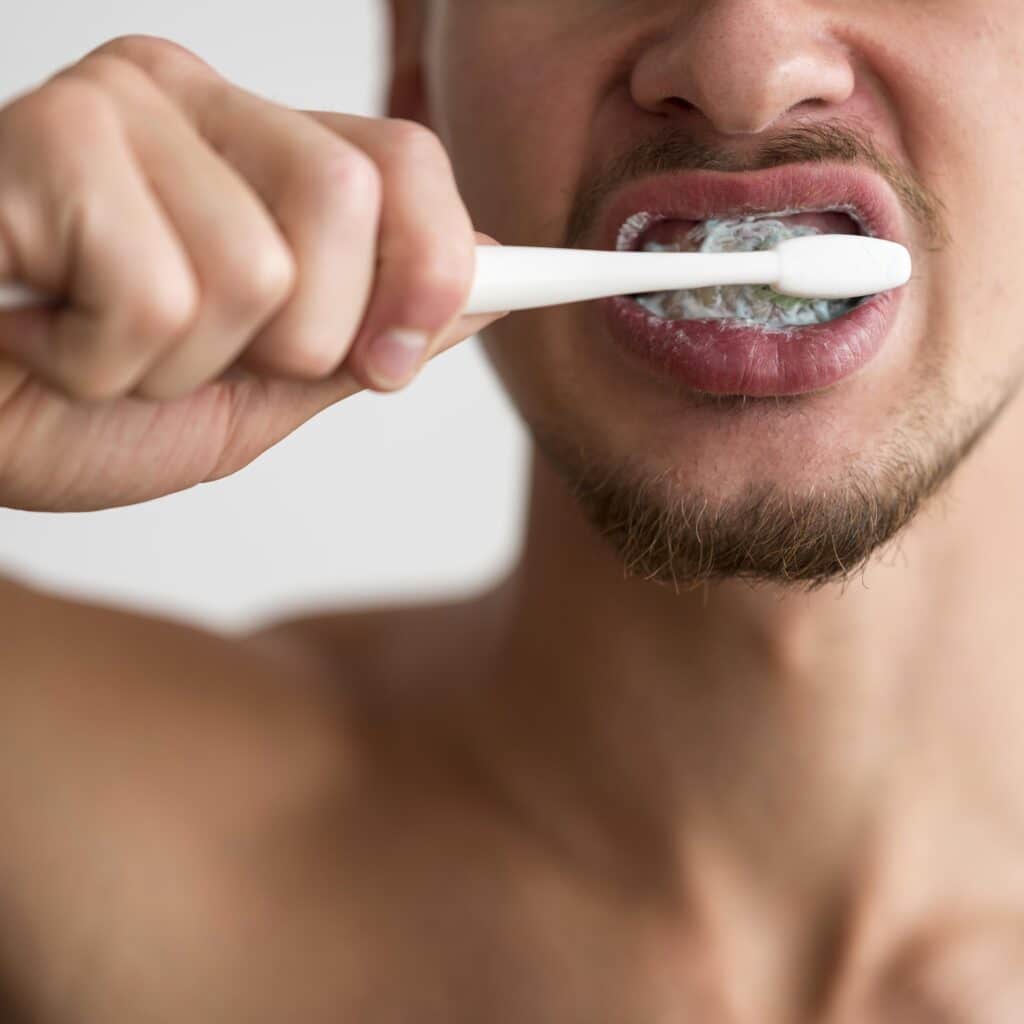
Quite often, when we look in the mirror while brushing our teeth, we notice a subtle change in our smile: some teeth seem to have become “longer” than usual, or the gum line seems to have shrunk back (what we call receding gums), revealing a more yellowish area. If on top of this cosmetic change you feel a sharp twinge when drinking cold water, your mouth is sending you a very clear warning.
This is a very common situation among the patients who visit us from Vélez-Málaga and the whole Axarquía area. At Clínica Dental Acosta Cubero, in Vélez-Málaga, we are experts in conservative dentistry, and today we want to talk to you about a very common problem that we often cause ourselves without realising: gum recession caused by traumatic brushing. Find out why scrubbing harder doesn’t mean cleaning better! 🛑
The myth that “a hard brush cleans better” 🤔
We’ve been taught since childhood that we need to brush thoroughly to avoid tooth decay, and we often link a deep clean with pressing hard or using a toothbrush with hard bristles. Big mistake!
Tooth enamel is the hardest substance in the human body, but the gum around it is extremely delicate tissue. If you “scrub” it every day with a hard brush or too much hand pressure, the gum protects itself by retreating: it recedes and exposes the neck and root of the tooth. 🛡️
The consequences of receding gums: exposed tooth necks ⚠️
The root of the tooth isn’t protected by enamel but by a much thinner, more porous layer called cementum. When this area is exposed because the gum no longer covers it, three main problems appear:
- Extreme sensitivity: thousands of micro-pores connect the root directly to the nerve of the tooth. Any stimulus (air, cold water, something sweet or even just the touch of the toothbrush) will cause a sharp, very painful twinge.
- Root (or neck) decay: because the surface is rougher and less resistant than enamel, bacteria get in far more easily, causing decay that quickly advances towards the nerve and is harder to fill.
- Cosmetic problem: the teeth look elongated and out of proportion, and the smile loses its natural harmony as the darker shades of the roots show. ✨
How do we fix it at Clínica Acosta Cubero? ⚙️
The first and most important thing at our clinic in Vélez-Málaga is to stop the damage. Once the gum has receded because of aggressive brushing, it doesn’t grow back on its own. To solve the problem, among our dental treatments we follow this protocol:
- Re-learning how to brush: we’ll teach you the correct technique. We’ll swap your toothbrush for one with soft bristles (or an electric toothbrush with a pressure sensor) and show you how to use gentle sweeping movements instead of “scrubbing as if you were sanding”.
- Sealing or filling the tooth neck: if the exposed root has worn away (creating a small step) or has decay, we’ll carry out a minimal restoration with composite matched to your tooth colour. This seals the root off from external stimuli, getting rid of sensitivity almost immediately.
- Mucogingival microsurgery (in severe cases): if the recession is very serious and threatens the stability of the tooth, our specialists can perform a small gum graft to cover and protect the exposed root again.
Look after your gums: they frame your smile! 😊
Good dental hygiene doesn’t have to be painful or aggressive. Treating your gums gently is the key to keeping them healthy and in place for life.
If you notice sensitivity at the necks of your teeth or see that your gum has shrunk back, get in touch with Clínica Dental Acosta Cubero in Vélez-Málaga and book your assessment. We’ll check your brushing and offer you the most conservative solution so you can eat and drink again without jumping out of your seat. Brush smart, not hard! ✨
